

AI Data Analyst Jobs in 2025: Skills, Responsibilities & Career Outlook
2025 is a great year to be a data analyst. Demand is strong, salaries are rising, and AI is expanding what analysts can accomplish—not shrinking the role. Generative AI now drafts queries, builds charts, and flags anomalies in seconds, but the analysts who thrive are the ones who ask the right questions, validate the outputs, and translate insights into decisions that move the business.
For B2B SaaS companies, this shift means analysts aren’t just reporting on the past—they’re shaping product roadmaps, guiding retention strategies, and influencing revenue growth. The role is evolving fast, and that’s good news if you’re ready to grow with it.
What AI Does vs. What Analysts Own
The role of the data analyst has shifted from data janitor to decision architect. AI handles speed; humans handle strategy.
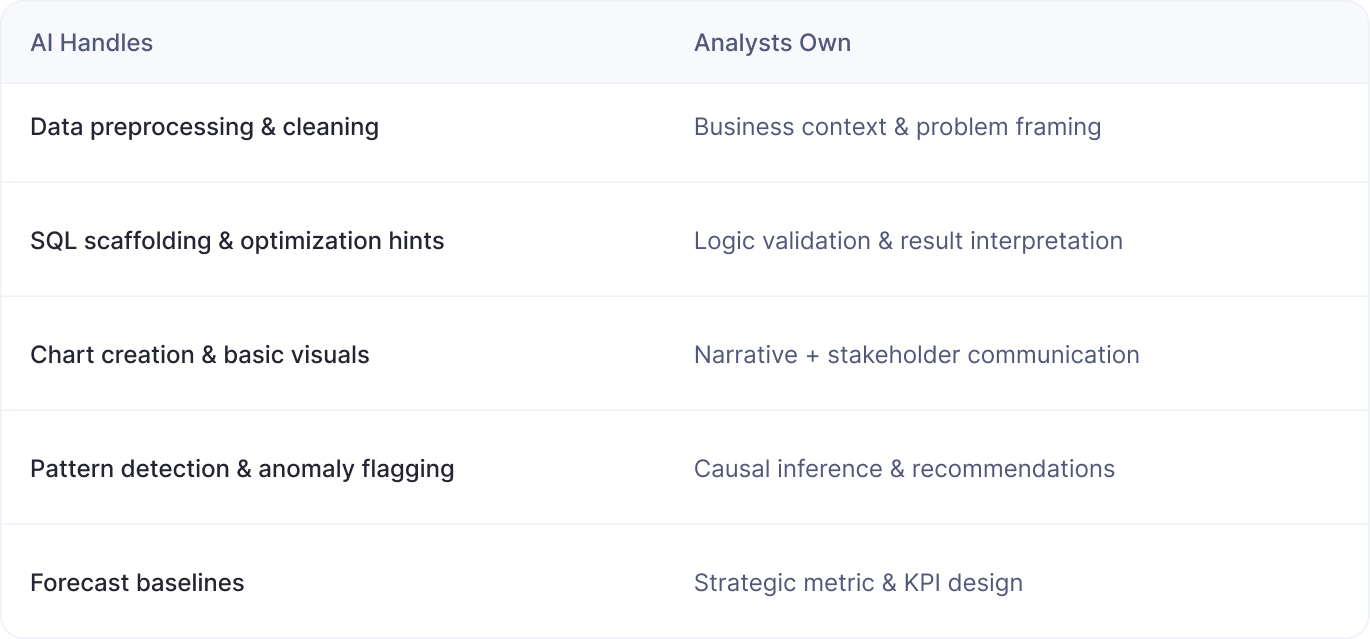
📌 Harvard Business Review put it best: what gets measured, AI will automate—so analysts must define what matters.
Core Responsibilities (2025)
1. Strategic Problem Architecture
Co-design questions with PMs, product teams, and revenue leaders. Build metrics that drive retention, efficiency, or expansion. Analysts now own KPI definitions, contract clarity, and cross-system data reconciliation.
2. Decision Intelligence
Craft decision memos, run experiments, and interpret model drift. Analysts are expected to bring hypothesis testing and business context into every insight.
3. Governance & Data Quality
Maintain metric lineage, define source-of-truth dashboards, and reduce cloud/tooling costs. Modern analysts treat quality as a first-order risk.
🔗 Want depth? Monte Carlo’s data observability playbooks are a must-read.
Must-Have Skills for 2025
The days of data analysts being judged on SQL alone are over. In 2025, hiring managers expect you to bring a hybrid toolkit: technical depth, AI fluency, and business storytelling. What matters is whether you can translate that query into a decision that moves revenue, retention, or product adoption.
1. Technical Fundamentals
SQL is still table stakes but the edge comes from mastering window functions, joins, and performance tuning. Why? Because when your product manager asks for churn cohorts segmented by expansion ARR, you need to slice the data cleanly and fast. Python follows right behind: automation scripts and statistical models are what let you test hypotheses instead of drowning in repetitive tasks. And don’t sleep on statistics. A/B testing, power analysis, and causal inference are how SaaS teams avoid vanity metrics and ship features that actually stick. See W3Schools SQL Tutorial and Python.org for foundational refreshers.
2. AI Integration
Generative AI has made text-to-SQL copilots, auto-summaries, and anomaly detection mainstream. But here’s the catch: every AI draft needs a human in the loop. Analysts who can validate outputs against raw data and orchestrate workflows across agents and copilots are the ones keeping leadership dashboards trustworthy. At Zapier, for instance, analysts now prototype workflows by chaining AI copilots with data quality checks—a skill that turns “flashy demo” into “reliable production pipeline.”
3. Business Communication
SaaS leaders don’t want dashboards; they want answers. The analyst’s job is to frame the “so what” in a way that a CRO, PM, or RevOps lead can act on. That means clear memos, tight stakeholder updates, and enough domain fluency to know why a retention metric in fintech looks nothing like one in ecommerce. The best analysts don’t just present data—they shape strategy.
Salary Outlook (US, 2025)
AI data analysts are well-paid—especially those who go beyond execution and into strategy.
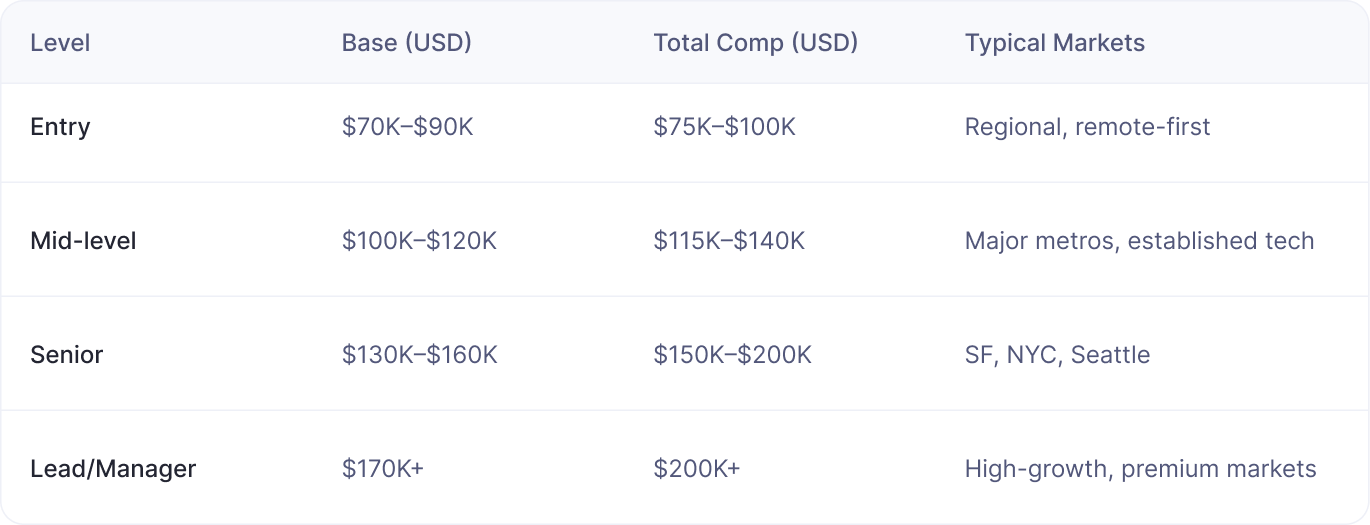
📊 Bench with Levels.fyi, Glassdoor, and BLS (Data Scientists avg: $112,590, +34% growth 2024–2034).
How to Stand Out: Portfolio & Interview
Hiring managers in 2025 aren’t impressed by a laundry list of tools—they’re impressed by evidence of impact. The best way to stand out is to treat your portfolio as a narrative of how you’ve turned analysis into business outcomes.
For example, an end-to-end project that starts with a messy question, frames a decision, and shows the outcome is far more compelling than a polished dashboard. Portfolios that highlight AI-assisted workflows with clear checkpoints where you validated the outputs—show that you know how to partner with machines, not just lean on them. And if you can quantify business value (think revenue lift, cost savings, or conversion improvements), you’re speaking the language that every SaaS recruiter and hiring manager understands.
Even the way you write your resume bullets matters. Instead of listing “SQL, Python, Tableau,” tell the story of impact:
- “Reduced reporting cycle by 40% via AI-assisted notebooks with anomaly detection & auto-generated documentation.”
- “Increased conversions by 15% through KPI redesign and query optimization.”
When it comes to interviews, expect a multi-stage process. Most U.S. companies run four steps: a recruiter screen to set expectations, a technical test of SQL/Python/stats, a case study (live or take-home), and finally, a stakeholder panel to see how you communicate and influence. Zapier, for example, now requires every analyst candidate to demonstrate AI fluency during this process is a sign of where the industry is headed.
Strategic Job Search Tips
Finding the right AI data analyst role in 2025 is less about chasing every LinkedIn posting and more about being strategic. Many of the best roles never hit job boards—they show up first on company career pages, or get quietly shared in curated platforms like Built In, Otta, or Welcome to the Jungle. Savvy candidates also build visibility in Slack communities, LinkedIn groups, and local meetups, where recruiters often scout talent directly.
Recruiters themselves are shifting. According to LinkedIn’s Future of Recruiting report, two themes dominate:
- Skills-based hiring → Companies care less about your job title and more about what you can actually do.
- AI fluency → Demonstrating you can integrate generative AI into workflows is no longer optional—it’s becoming baseline.
The easiest way to get ahead? Maintain a live portfolio that showcases GenAI integration, human-in-the-loop proof points, and a clear tie to business results. When a recruiter Googles you, they should find more than a static resume—they should see evidence that you’re already working like a 2025 analyst.
Career Outlook & Role Resilience
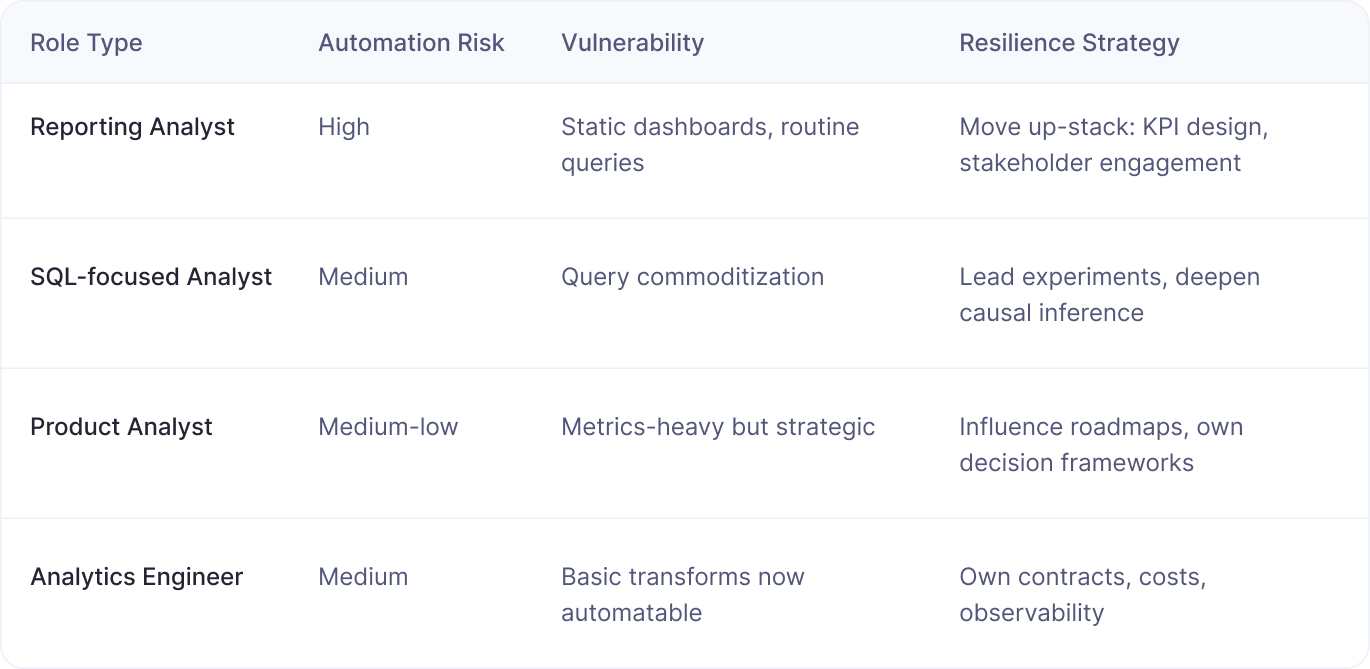
AI is changing the execution layer—but analysts who own what to measure, and why, will always be needed.
Conclusion
If you want to be an AI data analyst in 2025, focus less on competing with AI and more on partnering with it. AI can draft queries and spot patterns, but your edge is framing the right questions, validating outputs, and turning insights into revenue, retention, or product wins.
Master the fundamentals, get fluent with AI tools, and practice decision storytelling. Build a portfolio that proves you can combine machine speed with human judgment. Do that, and you won’t just have a job—you’ll have a career that stays in demand as analytics evolves.