

Why This Question Matters More Than Ever
Five years ago, the term “AI Data Analyst” didn’t exist. Analysts were analysts: they cleaned data, ran SQL, built dashboards, and told stories with numbers. Engineers were engineers: they wrote production code, deployed systems, and maintained the infrastructure behind the scenes.
But 2025 looks very different. Generative AI has blurred the lines between what analysts can do, what engineers build, and what AI itself automates. Today, job seekers face a new set of choices. Should you double down on the traditional Data Analyst path, lean into the hybrid AI Data Analyst role, or go deep into systems as an AI Engineer?
This isn’t just a résumé question. It’s a career strategy decision that shapes your skills, your compensation, and even the kind of influence you’ll have inside a company. This guide unpacks those roles, not as static job descriptions but as living career tracks complete with narratives, real-world case studies, and a decision framework to help you map your path.
The Roles at a Glance: Three Lanes, Three Types of Value
At a high level, all three roles work with data and intelligence. But the way they create value is very different:
- Data Analyst → delivers clarity through insight. Their superpower is turning messy, ambiguous business questions into crisp metrics and decision-ready answers.
- AI Data Analyst → amplifies the analyst mission with AI. They use automation, copilots, and AI-driven exploration to cover more ground, faster, while still applying human judgment to keep outputs trustworthy.
- AI Engineer → builds the systems of intelligence. Their work doesn’t end with insights—it ends with production-grade pipelines, APIs, and models that run inside products and operations at scale.
Think of it this way: the Analyst explains the “why,” the AI Analyst accelerates the “why,” and the Engineer builds the “how.”
A Day in the Life: Stories From the Field
The Data Analyst: Credibility Through Insight
It’s 9 a.m. A product manager pings you: “Trial sign-ups dropped last week. Can you find out why?” You log into BigQuery, write a dozen SQL queries, and slice the data across user segments. By afternoon, you’re presenting a deck: the dip was isolated to mobile users on iOS, likely tied to a new onboarding flow. The VP nods. Decisions are made.
That’s your impact. You don’t just pull numbers—you translate them into stories that leaders can act on. Your credibility is built on rigor and clarity.
The AI Data Analyst: Speed and Breadth Without Burnout
Same morning. Same problem. But your workflow looks different. Instead of manually combing through data, you use an AI-powered exploratory analysis tool. Within minutes, it suggests anomalies and highlights device-specific trends. You validate the outputs, refine the logic, and let AI draft the first version of your narrative.
By noon, you’ve already shipped a dashboard with automated alerts and a scenario model showing what happens if the trend continues. You didn’t cut corners; you expanded coverage. The difference is that AI handled the repetitive grind so you could test more hypotheses in less time.
The AI Engineer: Intelligence Embedded Into Systems
Now imagine you’re not building decks at all. You’re writing code. Instead of explaining why sign-ups dropped, you’re deploying a real-time model that predicts churn risk and auto-triggers interventions: discount codes, chat prompts, or a simplified flow.
Your stakeholders are engineers as much as executives. Your work is less visible day-to-day, but it’s embedded directly in the product. Success is measured not in slides presented but in systems that run reliably at scale.
Real-World Differentiation: When Roles Diverge
Let’s ground this in two industries where the differences are stark:
E-commerce (reducing cart abandonment):
- Data Analyst: Runs funnel analysis, calculates ROI of fixes, and advises the UX team.
- AI Data Analyst: Uses AI-accelerated journey mapping and anomaly detection to highlight where customers drop off, then auto-generates an executive dashboard with prioritized actions.
- AI Engineer: Deploys a predictive model that intervenes in real time, preventing abandonment before it happens.
Financial Services (credit risk assessment):
- Data Analyst: Designs scorecards, analyzes default patterns, and produces regulatory reports.
- AI Data Analyst: Automates feature engineering, builds stress-test scenarios, and delivers validated dashboards with compliance built in.
- AI Engineer: Ships retrainable credit models, manages scoring APIs, and ensures governance and auditability across the system.
In both cases, the Analyst explains, the AI Analyst accelerates, and the Engineer automates.
Skills & Tools: How the Stacks Compare
One of the clearest ways to see the differences between these roles is to look at the skills they rely on and the tools they live in every day. Think of it as three different “toolboxes,” each designed for a specific kind of work.
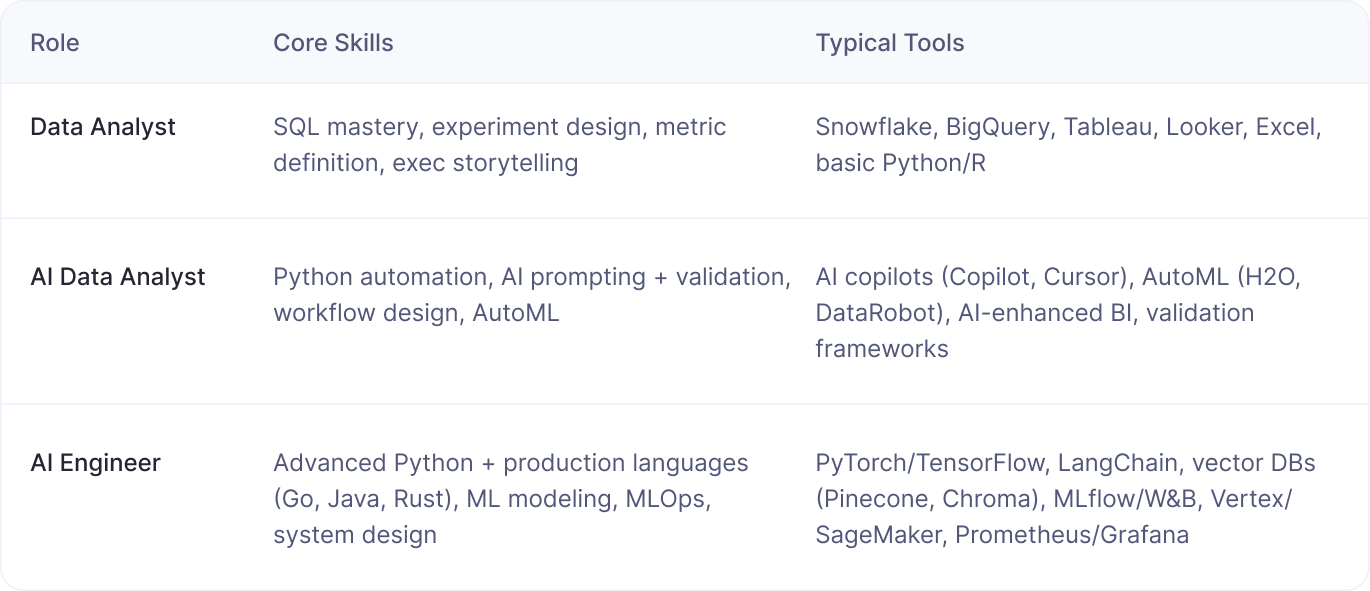
Takeaway: Analysts use tools, AI Analysts extend them, and Engineers build them.
Compensation: Where the Money Is in 2025
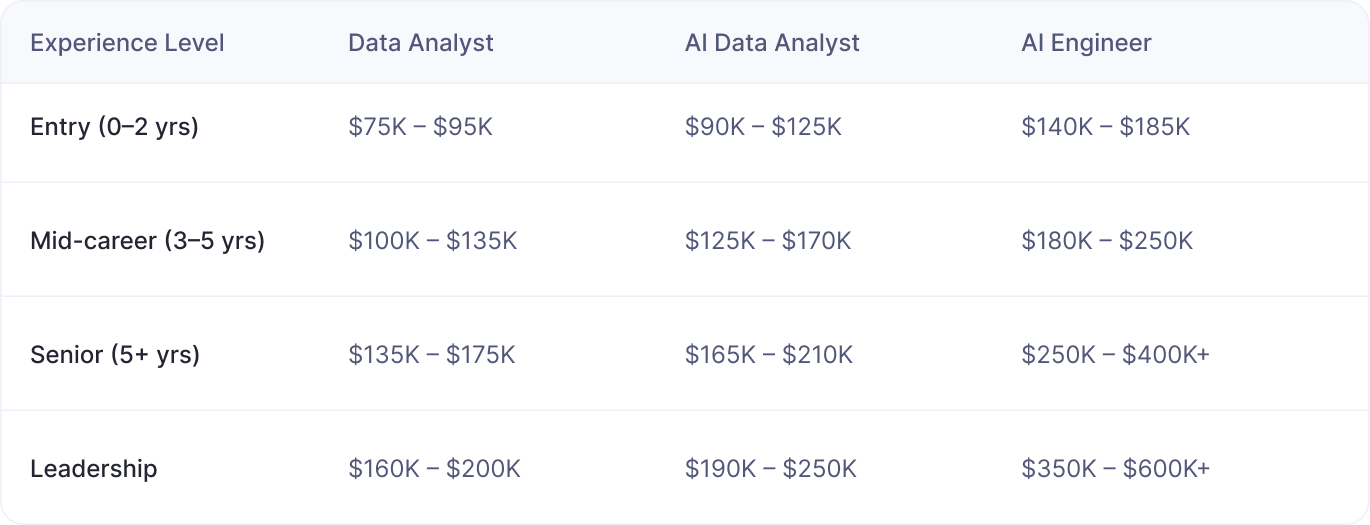
Salaries vary widely depending on role, experience, and geography. Here’s a snapshot of estimated U.S. compensation ranges in 2025:
Key Context
- Geography matters: SF, NYC, and Seattle command +25–40% premiums.
- Industry matters: fintech and healthcare pay 10–20% higher; government and non-profits often lag 20–30%.
- Career velocity differs: AI Engineers hit the highest ceilings, but AI Data Analysts often climb fastest into leadership because of their cross-functional influence.
Decision Framework: Which Role Fits You?
Choosing between these three roles isn’t just about titles or hype—it’s about matching your strengths and motivations with the kind of value you want to create. Think of it as three different career “mindsets”:
The Data Analyst: The Interpreter
If you thrive on conversation with stakeholders, enjoy untangling messy business questions, and love the art of turning raw data into stories executives can act on, the Data Analyst path will feel natural. Your influence comes not from code, but from clarity—the ability to define what matters and communicate it with conviction.
The AI Data Analyst: The Accelerator
If you’re excited by innovation and speed, and you see AI as a way to multiply your reach without the full weight of engineering, then the AI Data Analyst role is built for you. You’ll spend your time experimenting with new workflows, automating the boring parts, and scaling your analysis across more questions and more stakeholders. It’s the sweet spot for people who want breadth, efficiency, and optionality in their careers.
The AI Engineer: The Builder
If your satisfaction comes from building systems that last, you’ll feel at home as an AI Engineer. This path is for those who love technical depth—coding, deploying, monitoring—and want their work to live inside the product, not just in a slide deck. It’s less about explaining the business and more about embedding intelligence directly into operations at scale.
The Bottom Line
Data Analyst, AI Data Analyst, and AI Engineer roles each reflect different ways of creating value with data in 2025. Some focus on clarity, others on acceleration, and others on building intelligence that runs at scale.
The best choice depends less on the title and more on your strengths and ambitions. No matter which lane you choose, the opportunity ahead is significant. Companies are hungry for people who can pair technical skill with business judgment, and the professionals who deliver both will find themselves in high demand. Your career strategy isn’t about chasing hype—it’s about choosing where you can deliver lasting impact and then doubling down.